
Why Is My Law Firm Not Showing Up in AI Search?
In 2025 and 2026, one of the most common questions we hear from law firms is:
“Why is my law firm not showing up in AI search?”
If your firm isn’t being cited or mentioned by AI platforms like ChatGPT, Perplexity, Google AI Overviews, or Gemini, you’re not alone. AI-driven search works differently from traditional Google search, and many law firms are still optimizing for yesterday’s rules.
In this guide, we’ll break down why your firm may be invisible in AI search results and, more importantly, what you can do to fix it.
Navigate This Guide
- What Is "AI Search," Exactly?
- The Large Brand Advantage (and How Smaller Firms Can Compete)
- Listicles: Still One of the Easiest AI Wins
- Google AI Overviews vs. Other AI Platforms
- Informational Queries: Where Most Firms Get It Wrong
- AI Prefers Direct Answers
- What AI-Optimized Law Firm Content Looks Like
- Structured Data: One of the Biggest Missed Opportunities
- Authorship, Attorneys and E-E-A-T Signals
- Research: Reverse-Engineering What AI Already Trusts
- Brand Consistency Still Matters. Maybe More Than Ever
- Third-Party Validation & Digital PR
- Why Hire Digital Law Marketing for AI Search Visibility?

What Is “AI Search,” Exactly?
AI search refers to large language models (LLMs) that generate direct answers to user questions instead of displaying a list of blue links. These platforms include:
- ChatGPT
- Perplexity
- Google AI Overviews & AI Mode
- Gemini
“Showing up” in AI search doesn’t necessarily mean ranking #1, it means:
- Being cited or referenced as a source
- Having your firm named as an authority
- Being linked or summarized in AI-generated responses
AI search is less about keywords and more about trust, structure, and consistency.

The Large Brand Advantage (and How Smaller Firms Can Compete)
Just like traditional SEO, large brands have an inherent advantage in AI visibility. The more frequently a firm is mentioned across trusted sources, the more confident an LLM becomes in citing that firm.
That doesn’t mean smaller or mid-sized firms can’t compete, but it does mean you must overcompensate strategically.
You do this by:
- Creating content AI models want to cite
- Making your firm easy to understand programmatically
- Reinforcing trust signals everywhere your brand appears
Listicles: Still One of the Easiest AI Wins
A listicle is content structured as a list ("Best," "Top," "Most Trusted," etc.).
For AI search, listicles are powerful because they directly answer comparative queries such as:
- “Best personal injury lawyers in Chicago”
- “Top medical malpractice firms in Ohio”
AI platforms frequently pull from list-based content when answering these questions.
Easy Listicle Win
Create a page titled:
“Best Personal Injury Lawyers in Chicago”
Place your firm at the top, then list legitimate competitors beneath you. We’ve repeatedly seen ChatGPT and Perplexity cite a law firm’s own listicle as long as it appears objective and consistent with the broader web.
Credibility matters. If the AI senses manipulation, it will skip you.

Google AI Overviews & AI Mode vs. Other AI Platforms
Google’s AI Overviews & AI Mode behave a bit differently than ChatGPT or Perplexity.
Google heavily favors:
- Google Business Profile reviews
- Brand prominence
- Location signals
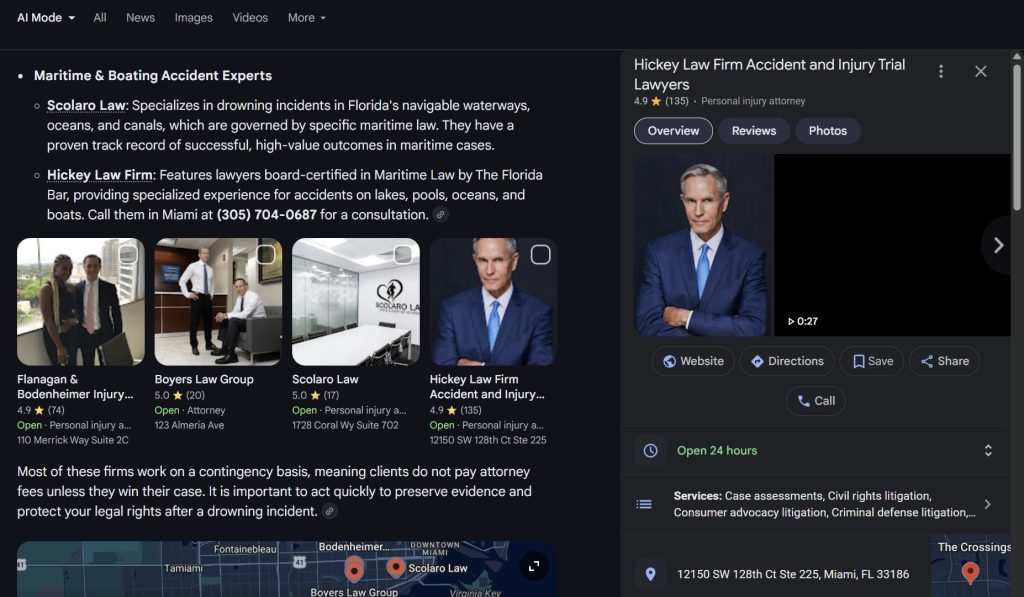
This means Google may link directly to a Google Business Profile instead of a law firm website or listicle. While listicles still help, Google appears to rely more heavily on review velocity, consistency, and entity confidence.

Social Media Mentions Are Important. Be Part of the Conversation.
One thing law firms often overlook is the power of community platforms like Reddit and other social networks in driving AI visibility. Today’s LLMs don’t just crawl your website, they learn from real, human conversations happening across the web. When people are asking questions, sharing links, and talking about legal topics on Reddit, X, Quora, or niche Facebook groups, those discussions become part of the broader data ecosystem that AI tools use to determine who to cite and why.
That matters because AI search isn’t about ranking keywords anymore. It’s about trust and relevance. When your firm or your content gets mentioned organically in public threads, that builds an extra layer of real-world credibility that models like ChatGPT and Google’s AI Overviews use to decide whether to include you in an answer.

Informational Queries: Where Most Firms Get It Wrong
Transactional queries (“best lawyer near me”) are only part of the equation. AI search is dominated by informational queries like:
- “What should I do after a car accident?”
- “What percentage does a personal injury lawyer take?”
- “How long do I have to file a claim in [state]?”
AI Prefers Direct Answers
AI models favor content that answers questions immediately and clearly.
Good example:
"In most cases, you have two years to file a personal injury claim in [State]."
Bad example:
"It depends on the circumstances of your case. While there are exceptions, the statute of limitations is generally two years."
Even if the second answer is legally safer, the first answer is more likely to be cited.
Nuance belongs after the direct answer, not before it.
What AI-Optimized Law Firm Content Looks Like
AI-friendly pages typically include:
- A direct answer in the first 1–2 sentences
- Short paragraphs (1–3 lines)
- Clear subheadings that mirror real questions
- Bullet points or numbered steps
- Plain-language explanations
Think less like a legal brief and more like an expert being interviewed.
Structured Data: One of the Biggest Missed Opportunities
LLMs rely heavily on machine-readable signals.
Law firms should be using structured data such as:
- LegalService schema
- LocalBusiness schema
- Attorney / Person schema
- FAQ schema
- Review schema
Structured data helps AI understand:
- Who you are
- What you do
- Where you operate
- Which attorneys are associated with which services
Authorship, Attorneys, and E-E-A-T Signals
AI platforms increasingly favor content tied to real people.
That means:
- Articles attributed to named attorneys
- Strong attorney bios connected to practice areas
- Content written from experience, not abstraction
Anonymous blog posts are less likely to be trusted than content authored by a licensed attorney with visible credentials.
Research: Reverse-Engineering What AI Already Trusts
Before chasing a keyword, ask:
- Who is the AI already citing?
- Are law firms even being referenced for this query?
- Is the AI using bullet points, paragraphs, or summaries?
You should be querying AI platforms repeatedly over time and documenting patterns. Many firms waste effort pursuing queries where AI consistently prefers government agencies, medical journals, or nonprofits instead of law firms.
Brand Consistency Still Matters. Maybe More Than Ever
LLMs rely on consistency to establish trust.
Your:
- Firm name
- Address
- Phone number
- Website URL
must match across trusted platforms like:
- Google Business Profile
- Avvo
- Justia
- Super Lawyers
- Yelp
Inconsistent data erodes confidence and reduces AI visibility.
Third-Party Validation & Digital PR
AI trusts brands that others talk about.
Mentions on:
- News sites
- Legal publications
- Community organizations
- Sponsorship pages
- Interviews and quotes
all reinforce authority. AI visibility is not just an on-site problem. It’s an ecosystem problem.
Why Hire Digital Law Marketing for AI Search Visibility?
AI search optimization is not guesswork. It’s pattern recognition, testing, and execution.
At Digital Law Marketing, we analyze:
- How AI platforms present answers in your market
- Which competitors are being cited
- Where your firm’s signals are breaking down
We offer a free AI visibility audit to show how your firm compares and where immediate opportunities exist.
If your competitors are showing up in AI answers and you’re not, now is the time to act.
Contact Digital Law Marketing today to start owning AI search rather than reacting to it.

Search engine optimization and generative engine optimization expert with almost 20 years of experience helping law firms find more visibility online and attract new clients. Steve Erlich is the Director of Search and Co-Founder of Digital Law Marketing.